


Outstanding employees are often promoted because they consistently deliver excellent results. Yet success as an individual contributor does not automatically prepare someone to lead people.
The first year in management is often the most influential period in a leader’s career. During this transition, new managers must learn to delegate, coach, communicate effectively, navigate difficult conversations, and build trust—all while continuing to deliver business results.
Choosing among the best leadership development programs for new managers can determine whether first-time managers become confident leaders or remain overwhelmed by responsibilities they were never taught to handle.
Organizations that invest in practical leadership development early create stronger teams, healthier cultures, and more consistent business performance.
The best leadership development program for new managers combines practical learning with coaching, real workplace application, peer collaboration, accountability, and ongoing reinforcement. Rather than relying on a one-time workshop, effective programs help managers consistently apply leadership skills in everyday situations, creating lasting behavior change that improves team performance and organizational results.
Why New Managers Struggle
Stepping into management represents one of the biggest career transitions professionals experience.
Instead of being responsible only for their own performance, managers become responsible for helping others succeed.
- Moving from doing the work to leading others
- Delegating instead of solving every problem personally
- Giving constructive feedback
- Coaching employees for growth
- Building trust quickly
- Managing former peers
- Balancing empathy with accountability
- Leading through uncertainty and change
These challenges are normal. They are not indicators of poor leadership potential—they simply reflect that leadership requires a different set of skills than technical expertise. This is why a structured new manager training program is far more valuable than expecting new leaders to learn through trial and error.
What Makes a Leadership Development Program Effective?
Traditional classroom instruction creates awareness. Effective leadership development creates behavior change.
The strongest programs combine practical application, expert coaching, guided reflection, reinforcement over time, manager tools and templates, peer discussion, real workplace scenarios, and accountability.
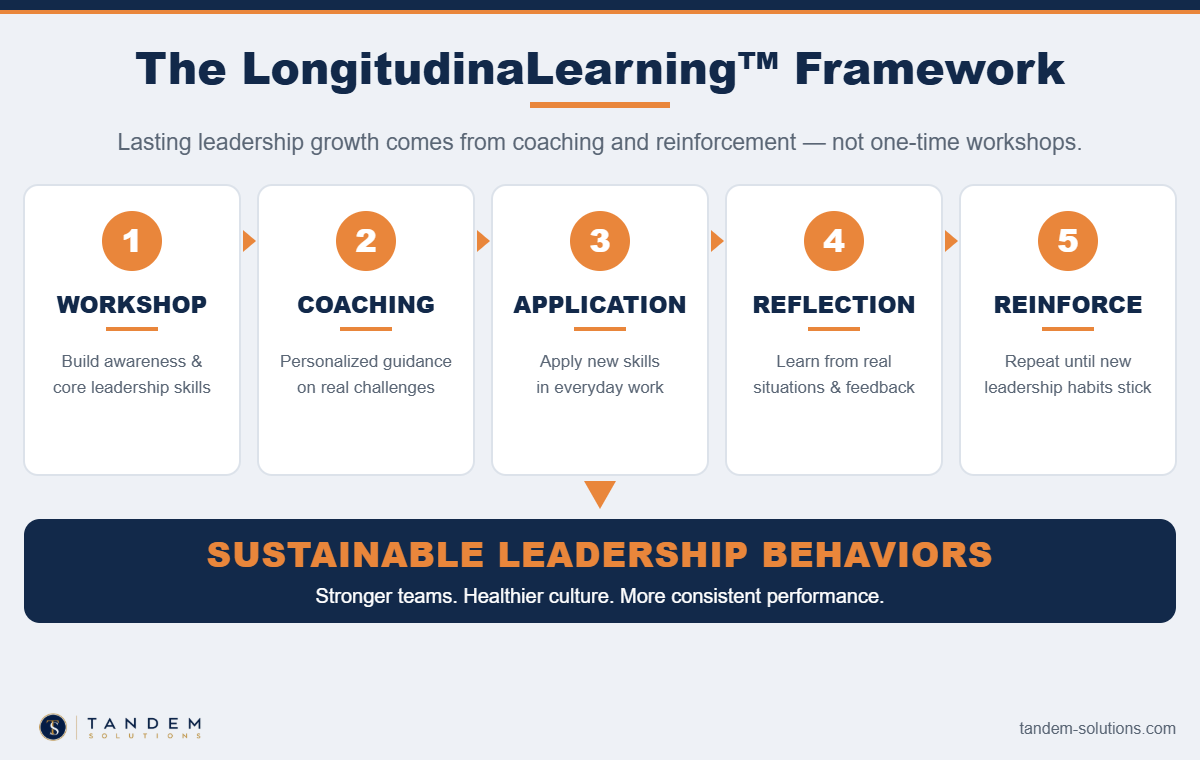
Leadership skills develop through repetition and feedback—not by listening to presentations alone. This philosophy aligns with Tandem Solutions’ LongitudinaLearning™ approach, which extends learning beyond workshops through coaching, application, and reinforcement.
Seven Qualities of the Best Leadership Development Programs
1. Built Around Real Manager Challenges
Managers should practice real conversations, difficult feedback, delegation, coaching, and team leadership—not hypothetical exercises.
2. Includes Coaching and Reinforcement
Without follow-up, even excellent training fades quickly. Ongoing coaching helps managers apply concepts when real situations arise.
3. Develops Communication Skills
Managers spend much of their day communicating. Programs should strengthen feedback, listening, coaching, conflict resolution, and decision communication.
4. Teaches Delegation and Accountability
Strong managers learn how to empower others rather than becoming organizational bottlenecks.
5. Builds Psychological Safety
Teams perform better when people feel comfortable asking questions, sharing ideas, and learning from mistakes. Learn more about psychological safety training.
6. Helps Managers Lead Change
Modern managers guide teams through continuous change. Programs should include practical approaches to influencing and adapting. See adaptive leadership training.
7. Measures Behavior Change Instead of Course Completion
Completion certificates measure attendance. Organizations should instead evaluate coaching behaviors, communication improvements, team engagement, delegation, trust, and accountability.
Traditional Leadership Training vs. Modern Leadership Development
| Traditional Leadership Training | Modern Leadership Development Program |
|---|---|
| One-time workshop | Multi-month learning journey |
| Knowledge transfer | Behavior change |
| Lecture-based | Practical application |
| Little follow-up | Ongoing coaching |
| Generic content | Real workplace scenarios |
| Completion certificates | Observable leadership behaviors |
| Limited accountability | Continuous reinforcement |
Warning Signs of Weak Leadership Programs
Be cautious if a provider offers one-day workshops as the complete solution, no follow-up coaching, generic leadership content, no practical tools, no peer learning, no accountability, no behavior measurement, or success measured only by completion certificates.
Leadership development should continue long after the classroom ends.
Leadership Development vs. Management Training
Management training typically teaches operational skills such as planning, delegation, performance management, and decision-making. Leadership development focuses on influencing people, building trust, creating alignment, and strengthening culture.
The strongest organizations combine both approaches. For a deeper discussion, see Leadership Development vs. Leadership Training.
Why Small Leadership Cohorts Often Produce Better Results
Smaller leadership development cohort experiences encourage greater accountability, meaningful discussion, practice in a psychologically safe environment, personalized coaching, shared learning, and better transfer into daily work.
One example is Tandem’s manager training program, which combines coaching, practical application, and reinforcement over time rather than relying on isolated training events.
Questions to Ask Before Choosing a Leadership Development Partner
- Does the program include coaching?
- What happens after the workshop?
- How is success measured?
- How much practice is included?
- Are managers working on real business challenges?
- How are new behaviors reinforced?
- Is the program scalable?
- What tools do participants receive?
Organizations should also evaluate whether the provider offers leadership development consulting that aligns learning with broader business goals.
Why Behavior Change Should Be the Goal
Organizations don’t invest in leadership development simply to increase knowledge. They invest because they want managers who coach effectively, communicate clearly, build trust, hold people accountable, improve execution, strengthen culture, and retain employees.
Tandem Solutions’ LongitudinaLearning™ philosophy recognizes that lasting leadership improvement happens through continuous learning, coaching, reflection, and reinforcement—not isolated events.
Key Takeaways
- Leadership success depends on behavior change, not workshop attendance.
- Coaching and reinforcement dramatically improve learning transfer.
- Small leadership cohorts create accountability and practical application.
- Effective programs develop communication, delegation, coaching, and trust.
- Measure leadership growth through workplace behaviors rather than course completion.
Frequently Asked Questions
What is the best leadership development program for new managers?
The best programs combine structured learning, coaching, practical workplace application, peer collaboration, accountability, and reinforcement so managers consistently apply leadership skills in real situations.
What should first-time manager training include?
A strong first-time manager training program should cover delegation, coaching, communication, feedback, accountability, conflict management, trust-building, and change leadership.
How long should a leadership development program last?
Leadership development is most effective when delivered over several months with coaching and reinforcement instead of a single workshop.
Is coaching important for new managers?
Yes. Coaching helps managers reflect on real challenges, receive personalized guidance, and build lasting leadership habits beyond classroom instruction.
How do you measure leadership development success?
Organizations should measure improvements in communication, coaching effectiveness, trust, accountability, team performance, and observable behavior change rather than attendance alone.
Invest in Better Managers, Not Better Workshops
The organizations that build exceptional leaders recognize that leadership is developed over time—not in a single event.
If you’re looking for a manager development program that goes beyond one-time workshops, explore the Manager Performance Cohort to see how practical leadership development, coaching, and reinforcement help new managers become confident, effective leaders.
For organizations seeking additional support, consider executive coaching for leaders and review the leadership development FAQ to learn more about Tandem’s approach.