


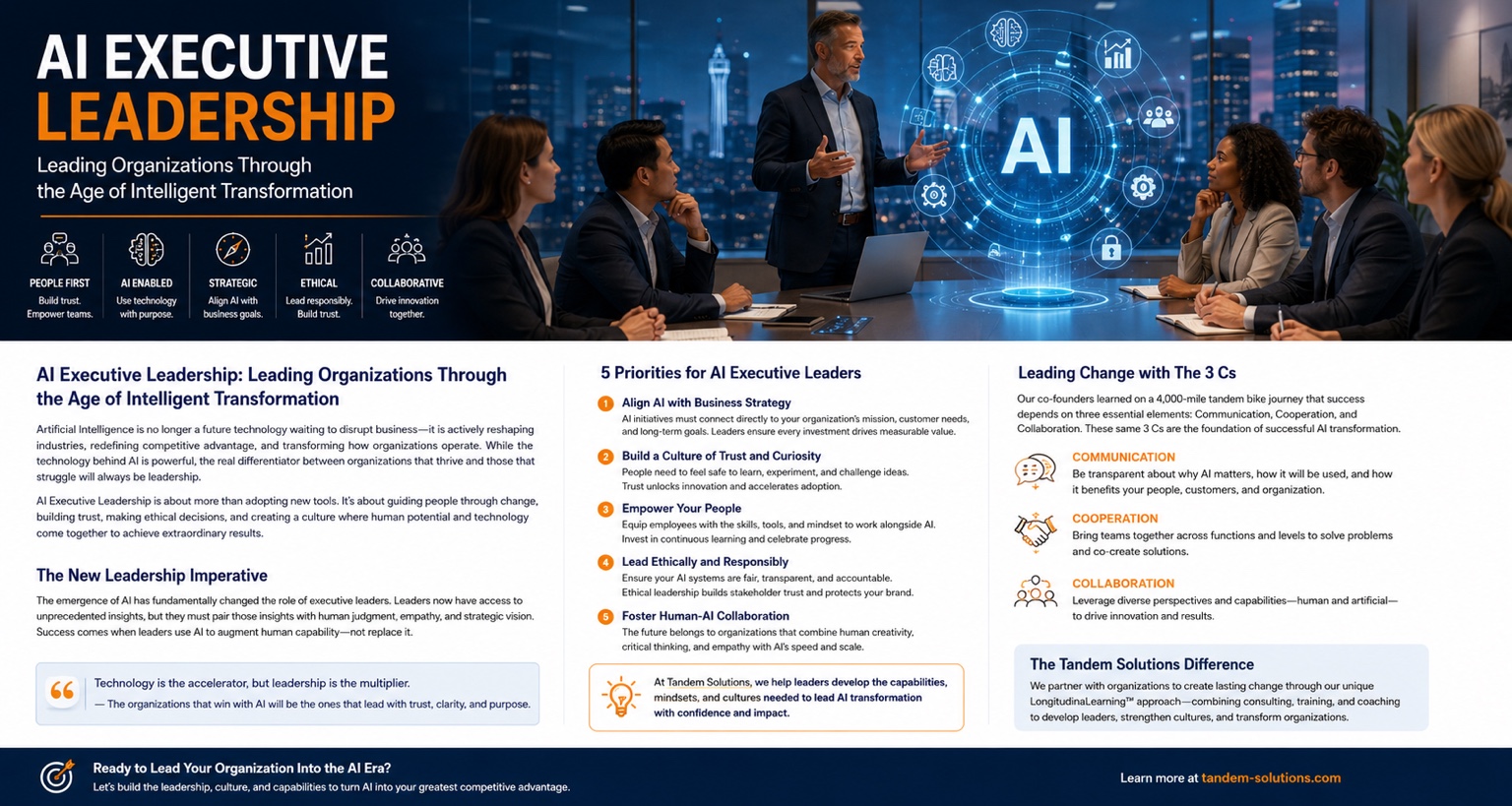
Save this image as a reminder of the leadership principles required to successfully lead organizations through the age of intelligent transformation.
AI Executive Leadership: Leading Organizations Through the Age of Intelligent Transformation
Artificial Intelligence is reshaping every industry, but technology alone does not create transformation. Leadership does. As organizations adopt AI-powered tools, executives must guide cultural change, build trust, and align innovation with business strategy.
The New Leadership Imperative
Executive leaders must move beyond viewing AI as a technology initiative. AI impacts decision-making, workforce development, customer experience, operations, and innovation. Leaders who connect AI adoption to strategic business outcomes are more likely to realize measurable value.
Successful AI leaders understand that human judgment, empathy, communication, and ethical decision-making remain irreplaceable. AI enhances leadership; it does not replace it.
Building a Culture Ready for AI
One of the greatest barriers to AI transformation is organizational culture. Employees often worry about job displacement, changing expectations, and uncertainty. Effective leaders address these concerns directly and create environments where learning and experimentation are encouraged.
At Tandem Solutions, we believe that high-performing teams are built on trust rather than fear. Innovation flourishes when people feel safe challenging ideas, sharing perspectives, and learning from mistakes.
The Shift from Command-and-Control to Curiosity
Traditional leadership models emphasized certainty and control. AI introduces complexity and constant change. Leaders who embrace curiosity encourage exploration, collaboration, and continuous learning throughout the organization.
Ethical Leadership in the AI Era
AI introduces complexity and constant change. Executive leaders must establish clear principles that ensure AI use aligns with organizational values and stakeholder expectations.
Developing AI-Ready Leaders
Modern leaders require strategic vision, learning agility, human-centered leadership, collaboration skills, and change management expertise. Organizations that invest in these capabilities position themselves for sustainable growth.
The Future Belongs to Human-AI Collaboration
The future of work is not about humans competing with machines. It is about leveraging the strengths of both. AI excels at analyzing data and automating repetitive tasks, while people excel at creativity, judgment, relationship building, and innovation.
Conclusion
The organizations that thrive in the AI era will be led by executives who build trust, foster collaboration, and create cultures that embrace learning and innovation. Effective AI leadership is ultimately about unlocking human potential while leveraging the power of intelligent technology.
Organizations looking to strengthen their AI leadership capabilities should also explore our perspectives on Leading in the Age of AI and how leaders can balance technological advancement with human-centered leadership.