

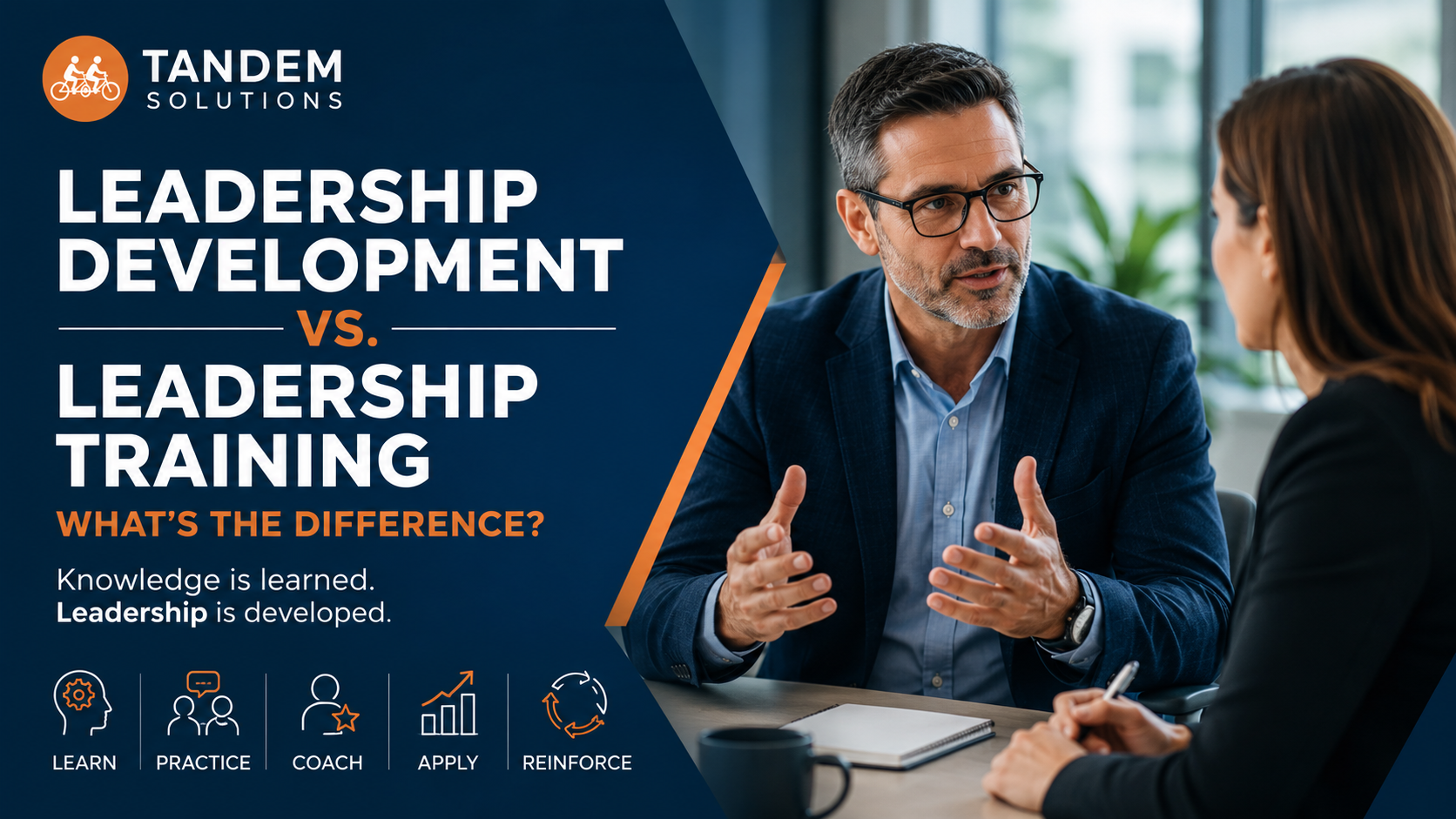

Many companies invest in leadership training and leave the room with energy, alignment, and good intentions. Then the pace of work returns. Old habits take over. Feedback conversations get delayed. Delegation remains unclear. Managers keep solving instead of coaching. When leaders do not behave differently, the question becomes: what went wrong?
The issue is often not the content. The issue is the difference between leadership development vs leadership training. Training can teach concepts. Development builds capability. Most organizations do not simply need leaders who know more. They need leaders who communicate, coach, delegate, adapt, build trust, and execute better under pressure.
What Is Leadership Training?
Leadership training is structured instruction designed to teach specific leadership concepts, skills, or frameworks. It gives leaders a common language, a practical model, and clear expectations for how a skill should be used.
Common examples include:
- Communication training
- Feedback training
- Delegation training
- Coaching skills training
- Conflict management training
- Change leadership training
Leadership training is valuable. It can create clarity quickly, especially when an organization needs leaders to understand the same framework or practice a specific skill. A well-designed session can help managers give better feedback, run stronger one-on-ones, or lead through uncertainty with more confidence.
The limitation appears when training is treated as the entire solution. A workshop can introduce a behavior, but it rarely rewires the habits that show up in real workplace pressure. Leaders may understand the concept in the room and still struggle when the conversation is emotionally charged, the deadline is tight, or the team is waiting for direction.
What Is Leadership Development?
Leadership development is a broader, ongoing process that helps leaders build judgment, self-awareness, confidence, habits, and measurable behavior change over time. It is not limited to a classroom event. It connects learning to the actual work leaders must do every day.
A strong leadership development approach may include:
- Training
- Coaching
- Assessments
- Practice
- Peer learning
- Reflection
- On-the-job application
- Reinforcement
- Business challenge application
This is where leadership development consulting becomes useful. The work is not only to select a topic and deliver a session. The work is to design the conditions that help leaders apply new behaviors consistently after the session ends.
Leadership development training should help leaders practice the moments that matter: setting expectations, asking better questions, giving candid feedback, holding boundaries, managing conflict, and adapting their style to the person and situation in front of them.
The Main Difference Between Leadership Development and Leadership Training
The practical difference is simple: training transfers knowledge. Development changes behavior.
| Leadership Training | Leadership Development |
|---|---|
| Focus: Specific concepts, skills, tools, or frameworks | Focus: Capability, judgment, habits, confidence, and behavior change |
| Time horizon: Often a single session or short series | Time horizon: Ongoing, reinforced, and connected to real work |
| Goal: Help leaders understand what to do | Goal: Help leaders actually do it when it matters |
| Format: Workshop, course, webinar, or class | Format: Training, coaching, practice, reflection, peer learning, and application |
| Measurement: Attendance, completion, satisfaction, knowledge checks | Measurement: Application, behavior shifts, manager consistency, business relevance |
| Best use case: Teaching a defined skill or common framework | Best use case: Building durable leadership capability across time |
| Risk if used alone: Short-term insight without follow-through | Risk if poorly designed: Too broad without clear practice and business connection |
That is the core distinction in leadership development vs leadership training. One helps leaders learn. The other helps leaders change what they do.
Why Leadership Training Alone Often Fails
Leadership training often fails for practical reasons, not because leaders are unwilling or the content is weak.
Leaders return to the pace of work. They leave the session with a tool, then step back into meetings, customer issues, performance concerns, hiring decisions, and operational pressure. Without reinforcement, the new behavior competes with familiar habits.
Managers are also overloaded. Even when they want to coach more effectively, delegate more clearly, or hold better one-on-ones, they may not have a realistic plan for how to practice. They may understand the concept but struggle to apply it in the actual conversation with the actual person on their team.
Another common issue is measurement. Organizations often measure completion instead of leadership behavior change. Attendance confirms that people were exposed to content. It does not confirm that managers are communicating expectations more clearly, giving better feedback, or building stronger trust.
Without coaching, structured reflection, manager support, and reinforcement, even strong training can become a short-term event instead of a long-term improvement.
When Leadership Training Is the Right Tool
Leadership training is the right tool when the organization needs clear instruction on a specific skill. It creates a shared baseline. It helps leaders understand what good looks like. It introduces practical tools that can be used immediately.
Training works well for topics such as:
- Giving better feedback
- Running better one-on-ones
- Delegating more clearly
- Understanding psychological safety training
- Learning a coaching conversation framework
- Leading through change
For example, a manager training program can be a strong choice when managers need a common language for expectations, feedback, coaching, and accountability. The key is to avoid treating the training session as the finish line.
When Leadership Development Is the Better Investment
Leadership development is the better investment when the goal is lasting change, deeper capability, and stronger leadership bench strength. It is especially important when the organization needs more consistent management practices, better cross-functional execution, improved culture, or stronger succession readiness.
Development is also a better fit when leaders must operate in ambiguity. In those moments, a script is not enough. Leaders need judgment. They need self-awareness. They need the confidence to pause, ask better questions, choose the right behavior, and adjust as conditions change.
This is why leadership development for managers matters. Managers translate strategy into daily behavior. They shape the employee experience through the conversations they have, the decisions they make, and the standards they reinforce. When managers grow, teams feel the difference.
How Tandem Combines Training and Development
Tandem Solutions helps organizations turn training into measurable behavior change by combining practical learning with application, coaching, and reinforcement. The approach is designed for leaders who need tools they can use in real workplace situations, not abstract ideas that sound good but disappear after the workshop.
Tandem’s LongitudinaLearning™ approach supports learning over time. Rather than relying on a one-time event, it uses bite-sized learning, TandemTools™, coaching, reinforcement, and application in real workplace situations. Leaders are encouraged to practice, reflect, and return to the work with clearer choices.
This matters because leadership behavior change requires repetition. Leaders need to try the behavior, notice what happened, adjust their approach, and try again. They also need support when the work gets difficult. That may include peer discussion, structured reflection, or executive coaching for leaders who need a deeper level of insight and accountability.
Tandem can also support specialized needs, including adaptive leadership training, manager capability building, team effectiveness, and leadership development programs that connect directly to business priorities.
What Buyers Should Look for in a Leadership Development Program
For CEOs, HR leaders, COOs, talent development leaders, and business owners, the buying question should not be, “Is the content good?” The better question is, “Will this help our leaders behave differently at work?”
Use this checklist before investing:
- Does it connect to real business problems?
- Does it include reinforcement after the session?
- Does it help leaders practice?
- Does it include coaching or structured reflection?
- Does it support managers in real workplace conversations?
- Does it measure more than attendance?
- Does it help leaders turn insight into action?
The strongest leadership development programs are practical and focused. They do not overwhelm leaders with content. They give leaders a clear behavior to practice, a reason it matters, a tool to use, and support for applying it in the flow of work.
Leadership Development Should Change What Leaders Do
The goal is not more content. The goal is better leadership behavior.
Organizations do not need leaders who can recite a model but avoid the hard conversation. They need leaders who can communicate clearly, coach with discipline, delegate with intent, build trust, and adapt under pressure. That is why the distinction between leadership development vs leadership training matters.
Training can be an important part of the solution. But development is what helps leaders use the training when the stakes are real.
If your organization is tired of leadership training that creates short-term energy but little follow-through, Tandem can help you build a leadership development approach that turns learning into real behavior change. Learn more about Tandem’s leadership development consulting.
FAQ
What is the difference between leadership development and leadership training?
Leadership training teaches specific skills, tools, or frameworks. Leadership development is a broader process that helps leaders build capability, judgment, confidence, and behavior change over time.
Is leadership training still valuable?
Yes. Leadership training is valuable when an organization needs clear instruction on a specific skill, such as feedback, delegation, coaching, communication, conflict management, or change leadership. It is most effective when it is reinforced after the session.
What should a leadership development program include?
A strong leadership development program should include practical training, coaching, reflection, practice, peer learning, on-the-job application, reinforcement, and a clear connection to business priorities.
How do you know if your organization needs leadership development?
Your organization may need leadership development if managers know the right concepts but struggle to apply them consistently, if leadership behavior varies widely across teams, or if the business needs stronger execution, trust, communication, and manager capability.
Ready to Build Leadership Development That Sticks?
If your organization is ready to move beyond one-time training and build leadership habits that show up in real work, Tandem Solutions can help you design a practical path forward.