

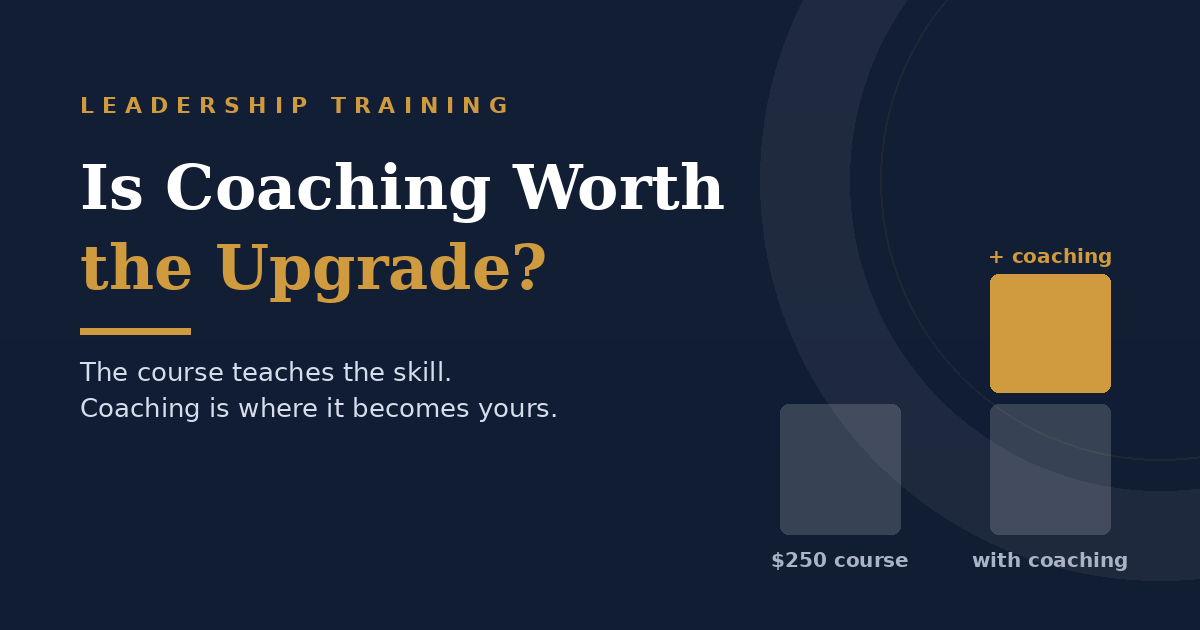

You can buy a leadership course for $250 and finish it in a weekend.
Neither of those facts changes how you lead on Monday.
That’s the uncomfortable truth about self-paced training, and it’s why the serious version of the product comes with coaching attached. Most providers sell that as an upgrade that can double or triple your total. A few build it into the price.
So is it worth it? For most people making a real leadership transition, yes. But not for everyone. Here’s the honest version, including who should keep their money.
What a Course Does Well, and Where It Stops
A good self-paced course earns its price three ways.
It gives you the framework. Delegation, feedback, coaching conversations, leading change: these are learnable structures, and a well-built course teaches them faster than trial and error.
It fits your calendar. No cohort schedule, no travel, no waiting for the next enrollment window.
It’s cheap relative to everything else. We broke down the full market in How Much Do Online Leadership Courses Cost?, and the $200 to $500 tier is where skill-per-dollar peaks.
Then the course stops. Because a course, by design, knows nothing about you.
It teaches delegation. It has never met the employee you don’t quite trust with the big account yet.
It teaches feedback. It doesn’t know your top performer cries in one-on-ones or that your boss undermines your decisions in front of the team.
It teaches change leadership. It has no idea your reorg was announced by email on a Friday.
The gap between knowing a framework and using it on your actual team is where most training dies. That gap is the entire reason coaching exists.
What Coaching Actually Adds
Three things, and they’re not what the brochures say.
Specificity. A course says “here’s how a delegation conversation works.” A coach says “walk me through delegating the quarterly report to Sam, given what you told me about Sam.” You leave the session with a plan for a real conversation happening this week, not a template.
Accountability. Knowing someone will ask “did you have the conversation?” changes whether you have the conversation. That’s not a character flaw. It’s how humans work, and it’s why gym memberships and personal trainers aren’t the same product.
A witness to your thinking. Your team can’t tell you your reasoning is off. Your boss won’t always bother. A coach’s job is to hear you think out loud and point at the step you skipped. Nobody else in your work life is paid to do that honestly.
Watching a video builds knowledge. Coaching converts it into behavior. Learning research has said this for decades: most real development happens on the job, not in the content. Our own take on that is the 70-20-10 approach, and coaching is what connects the 10 percent (the course) to the 70 percent (your actual work).
How Training With Coaching Works in Practice
The mechanics matter, because a coaching add-on done badly is just an expensive phone call.
In Tandem Academy, the coaching comes with the membership: $1,000 a year for all nine courses, an AI coach for short weekly working sessions, and live small-group coaching with experienced Tandem coaches, capped at ten people, where you submit your real challenge ahead of time.
The part that makes it work: sessions happen while you’re applying the material, not after you finish watching. You bring the real situation. The delegation you’re avoiding. The former peer who’s testing you. The change announcement you have to make next week. The course gives you the tool, and the session is where you fit it to your hand.
That sequencing is the difference between coaching as reinforcement and coaching as decoration.
What a Session Actually Looks Like
If you’ve never been coached, the word can sound vague. Here’s the concrete version of a good first session.
You show up with a situation, not a topic. Not “I want to get better at feedback.” Instead: “I have a strong performer whose work slipped this month, and I’ve been avoiding the conversation for two weeks.”
The first twenty minutes are questions. What have you tried? What are you assuming about why the work slipped? What’s the cost of another two weeks of silence? Somewhere in there, you usually hear your own thinking clearly for the first time, and at least one assumption falls apart out loud.
The middle is the work. You connect the course tool to the real case: structure the conversation, choose the opening line, decide what you’ll ask instead of tell. Some coaches will have you say the opening line out loud until it sounds like you and not like a script.
The last ten minutes are commitment. What exactly will you do, by when, and what will you both look at next session to judge how it went.
Then you go have the conversation. That’s the point. The session isn’t the development. The conversation on Tuesday is the development. The session is what makes sure Tuesday happens.
Multiply that across a year of weekly check-ins and live sessions, and you can see why the behavior change compounds: every module ends in a real action on your real team, witnessed by someone who’ll ask about it.
The Math
Put the options side by side.
A subscription content library: $240 to $400 a year, no coaching.
Tandem Academy: $1,000 a year, with nine courses and the coaching already in it.
A university certificate: $1,850 to $1,949 for the Harvard Business School Online leadership course, and $2,000 to $4,000 for comparable programs.
A live cohort program: $2,000 to $8,250 through providers like the Center for Creative Leadership.
Most people compare these on cost per hour of content. Wrong metric.
The right metric is cost per behavior that actually changes. A certificate you complete and shelve produced zero behavior change at $1,900. A $1,000 membership that gets you delegating, giving real feedback, and running better one-on-ones is the cheapest option on the list, whatever the sticker says.
Quick test: think of the last training you completed. Name one thing you do differently today because of it.
If you have an answer, that training was worth something. If you don’t, the price didn’t matter.
Who Should Skip the Upgrade
Coaching isn’t for everyone, and pretending otherwise would make the rest of this article worthless.
Skip it if you already have a manager who actually coaches you. Someone who watches your leadership up close, gives you honest feedback, and helps you work through specific situations weekly. That’s rare, but if you have it, you’re covered. Buy the course and use your manager.
Skip it if you’re exploring, not transitioning. If you’re reading about leadership out of curiosity rather than stepping into a role, the course alone is the right spend. Come back for coaching when the stakes are real.
Skip it for now if budget is genuinely tight. $1,000 is real money. Start with the free book on the Academy page, apply what’s in it, and join when the stakes are real. Waiting well is a fine decision.
Who Gets the Most From It
The pattern in who benefits is consistent.
You’re in the first 90 days of a new leadership role. Everything is live ammunition: the relationships, the expectations, the first hard conversations. Coaching during that window compounds. This is exactly the situation we wrote about in why your best employee may be struggling as a new manager.
You’re facing one specific hard thing. A friend who now reports to you. A team that’s missing deadlines. A boss you can’t read. Courses cover categories. Coaching handles your case.
You have no support system at work. No mentor, no peer group, no manager worth learning from. A coach is the fastest replacement while you build the rest.
You’ve done training before and nothing stuck. That’s not evidence you can’t develop. It’s evidence that content alone doesn’t change your behavior, which puts you in the majority.
If You’re Comparing Providers
Whatever provider you’re evaluating, ask four questions before paying for a coaching add-on.
Is the coach an experienced practitioner, or a recent certificate holder reading from a guide? Ask who you’d be working with.
Is the coaching tied to the course content, or is it generic mentoring sold at a markup? The session should reference the tools you just learned.
Will sessions be built around your real work? If you can’t bring this week’s actual problem into the session, it’s a lecture, not coaching.
Is the price on the page? Providers who publish their coaching prices are telling you they don’t need a sales call to justify them. For senior leaders weighing a bigger engagement, standalone executive coaching is the comparison worth making.
Try It the Low-Risk Way
You don’t have to decide the whole thing today.
Grab the free book at Tandem Academy, or book the 20-minute session and watch a coach work on your situation before you spend anything. If it lands, membership is $1,000 a year: nine courses, an AI coach, live group coaching, all in. If your organization is developing several managers at once, our leadership development programs bundle both from the start.
The course teaches the skill.
Coaching is where it becomes yours.