


Most organizations already have a process for measuring manager effectiveness. They run annual engagement surveys, collect 360-degree feedback, and generate competency ratings that get filed into development plans. And yet, when you ask HR and L&D leaders whether those instruments are actually changing manager behavior, the answer is almost always the same: not reliably, and not in ways we can prove.
This piece makes a specific argument: knowing how to measure manager effectiveness requires moving away from satisfaction ratings and abstract competency scores toward a narrow set of observable, coachable behaviors tied directly to team outcomes. It then requires capturing data at three distinct points in time to isolate what actually changed and what held.
What follows covers the core failure modes in traditional measurement, the behavioral dimensions that actually predict team performance, a three-point measurement model built to isolate real change, and why getting this right fundamentally shifts the ROI conversation for any management development investment.

The Measurement Problem Most HR Teams Are Sitting With
This piece is written for HR, L&D, and executive buyers at mid-market and enterprise companies. If you already run manager training and collect some form of post-training survey, this argument is for you.
The dominant measurement instrument in most organizations is a satisfaction survey: a Net Promoter Score or a five-point rating collected at the end of a training event. It is fast, inexpensive, and almost entirely useless for evaluating whether managers changed how they lead. Satisfaction scores measure whether participants enjoyed the experience. Follow-up processes are widely neglected in practice, meaning the data collected rarely drives any action.
The gap this creates is predictable. HR reports a high satisfaction score. Executives assume behavior changed. Ninety days later, nothing is different on the team. The problem is not that the training failed; it is that the measurement instrument was never designed to detect behavior change in the first place. This is why untrained managers drive outcomes that satisfaction surveys never capture, including turnover, disengagement, and missed performance.
The core argument of this piece: measuring manager effectiveness requires defining the specific behaviors that drive team outcomes, then measuring those behaviors at three points in time. Not rating abstract competencies once. That specificity is what separates a measurement instrument that produces a report from one that produces a change.
Why Satisfaction Surveys Cannot Tell You Whether a Manager Changed
The problem runs deeper than survey design. Research on why most manager training fails to transfer traces the issue to a foundational number: training alone transfers to job performance at approximately 5 to 10 percent without reinforcement (Baldwin & Ford, 1988; Joyce & Showers). A satisfaction survey collected at the end of that event is measuring the wrong thing entirely.
A high score on a low-transfer event is a false signal. It confirms that managers found the training worthwhile. It says nothing about whether any behavior changed the following Monday, or ninety days later.
The problem compounds when the instrument uses abstract competency ratings. “Communicates effectively: 3.8 out of 5.” That number does not tell a manager which specific behavior to change, and it does not tell a coach where to intervene. A score of 3.8 on delegation could mean the manager over-directs, under-follows-up, assigns work above the team’s skill level, or all three. The rating collapses distinctions that are essential for any targeted coaching response.
The result is a measurement system that consumes HR budget, produces slide decks, and drives no corrective action. Executives see the scores, assume development is occurring, and remain unaware that the delta between training and actual job behavior is close to zero.
What Behavioral Measurement Actually Requires
Behavioral measurement identifies the discrete, observable actions a manager must take to produce results, not the qualities they should possess.
That distinction decides whether a measurement instrument is coachable. “Is this manager accountable?” is a judgment. “Does this manager address a performance gap within forty-eight hours of observing it?” is a question a rater can answer by recalling what they actually saw. The first produces a score. The second produces a coaching target. Every question in a behavioral instrument should meet that test.
The behaviors selected must connect to team outcomes, specifically retention, productivity, and quality, not to training modules delivered. If a behavior cannot be traced to a measurable team result, it belongs in a values document, not a measurement tool. This keeps the instrument honest: it reflects what the business needs from managers, not what the training vendor chose to teach.
Rater choice matters as much as question design. Direct reports can describe their experience of a manager’s behavior, which is valuable for culture and engagement work. But only the manager’s own boss has consistent visibility into whether specific leadership behaviors are occurring day to day. That is the rater a manager effectiveness survey built for behavior change should use.
Resist the organizational pull to measure everything. Broad instruments dilute focus and reduce the probability that any single finding drives action. Narrow instruments, built around the behaviors with the highest predictive value for team performance, produce data a coach and a manager can actually use the following week.
The Five Dimensions of Manager Effectiveness Worth Measuring
Those high-predictive behaviors narrow down to five dimensions. Each one is specific enough to observe, score, and coach.
Clear expectations. Does the manager define what success looks like for each team member, including specific standards and consequences, before work begins rather than after it falls short? Correcting a gap after the fact is a management failure, not an employee one.
Coaching conversations. Does the manager hold regular one-on-ones focused on performance development, not just task status, and does each conversation end with a specific next action? A check-in that produces no commitment produces no change.
Delegation. Does the manager assign work at the appropriate level of authority, explain the outcome required rather than the method, and step back without micromanaging or abandoning? Both failure modes, hovering and disappearing, produce the same result: a team that stops developing.
Accountability. Does the manager follow up on commitments, address gaps directly when they occur, and distinguish between a performance issue and a capability issue? Those two diagnoses require different responses, and conflating them is one of the most common manager errors in practice.
Feedback and trust. Does the manager deliver specific, timely feedback, both corrective and affirming, and does the team demonstrate trust in the manager’s consistency and fairness? Trust is not a feeling; it is the accumulated evidence of whether the manager behaves the same way twice.
These five dimensions form the framework behind the Tandem Solutions Manager Effectiveness Index. Fifteen specific behaviors sit across them, scored by each manager’s own boss. You get a number. You get it three times.
The Three-Point Measurement Model That Isolates Real Change
Knowing which behaviors to measure solves half the problem. The other half is when to measure them.
A single post-training score cannot separate real change from temporary compliance, the three-point model addresses that directly.
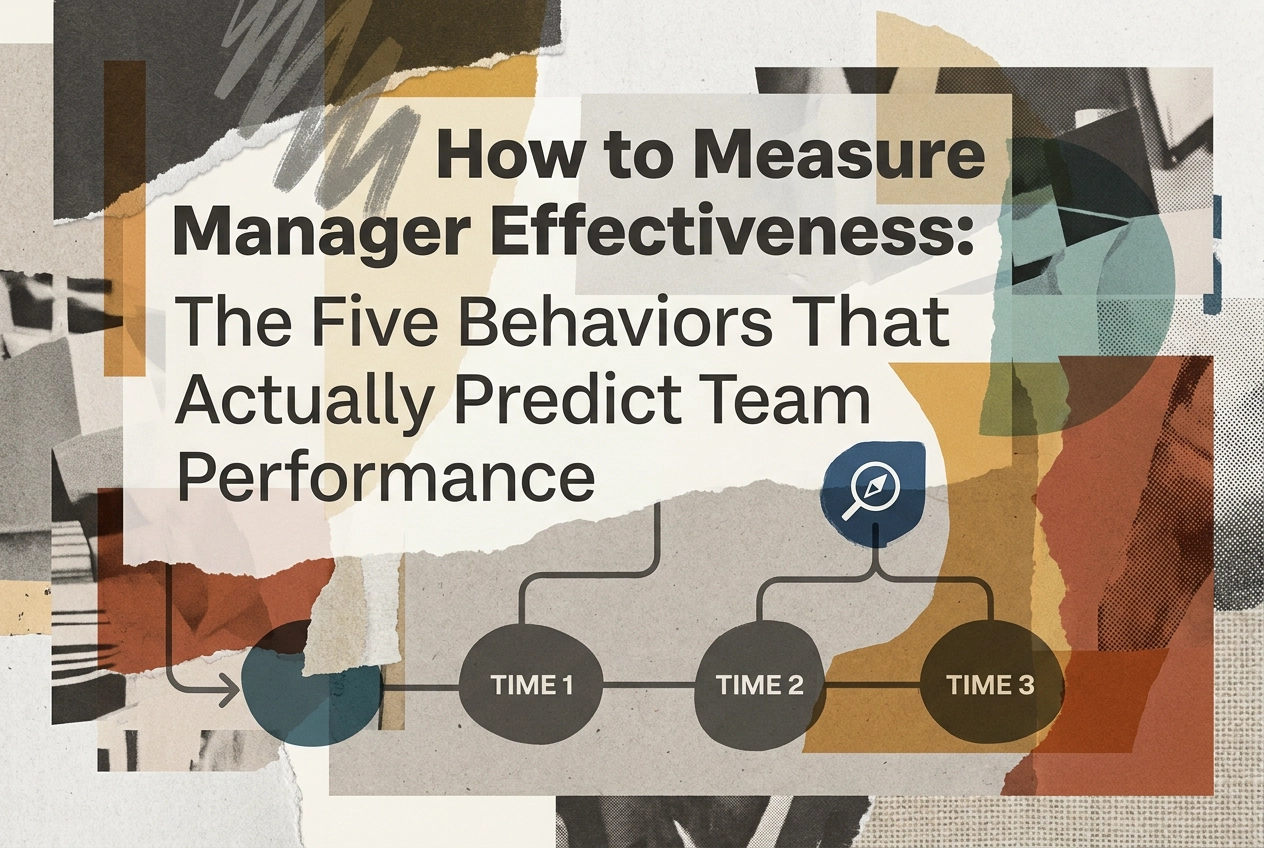
The Manager Effectiveness Index applies three measurement points to the same fifteen behaviors, scored each time by the manager’s own boss.
Point one, baseline. Before training begins, the boss scores all fifteen behaviors. This establishes which behaviors are absent, inconsistent, or already present and prevents a common distortion: managers who start high appearing to improve less than managers who start low.
Point two, endpoint. The same rater scores the same behaviors at the close of the program. This captures immediate behavioral shift and identifies where coaching should concentrate during the transfer period that follows.
Point three, ninety days post-training. The same rater scores the same behaviors again. This is the measurement that matters. It shows which changes held under real job conditions and which regressed without reinforcement. This is where the before-and-after delta becomes visible, connecting specific behavior change to team performance data the organization already tracks, not to a satisfaction score.
Ninety days is Tandem’s chosen window, long enough to distinguish lasting habit from temporary compliance, short enough to take corrective action if regression appears.
Why the Measurement Model Only Works With Coaching Between the Points
The three-point model is only as useful as what happens between the measurements.
Training alone transfers to job performance at 5 to 10 percent. The same content reinforced with coaching transfers at 80 to 90 percent (Baldwin & Ford, 1988; Joyce & Showers). That gap is not a training design problem. It is a transfer problem, and measurement does not solve it. Without structured coaching between the baseline and the ninety-day score, the instrument documents failure rather than drives change. The delta is small, or negative.
Coaching in this context is not encouragement. It is structured behavioral accountability: reviewing which specific behaviors scored low, identifying the situational barriers to each, and building a concrete plan for the next thirty days. That sequence, repeated across the transfer period, is what moves scores.
The Tandem Solutions Manager Performance Cohort operates precisely in this space. Enterprise cohorts run eight to twelve weeks, measured at all three points, with coaching built into the transfer period. Organizations that meet program conditions are covered by the Ninety-Day Behavior Change Guarantee: if scores do not improve, Tandem runs another coaching cycle at no charge.
For organizations that cannot fund an enterprise cohort, Tandem Academy provides the same behavioral framework at $1,000 a year or $99 a month. An AI coach is available every week of the year. Live group coaching is capped at ten seats. The transfer-support model is accessible at a self-serve price, without the enterprise price tag.
How to Build a Manager Effectiveness Survey That Produces Usable Data
The survey design follows from the measurement model. Once coaching is in place between the three data points, the instrument must be built to produce data a coach can actually use.
Start with the team outcomes the organization already tracks: voluntary turnover, output quality, project completion rates. Work backward from each to identify which manager behaviors most directly influence it. That sequence keeps the survey anchored to business results rather than training content.
Translate each behavior into a frequency-scaled question the manager’s direct supervisor can answer from observation. “In the past thirty days, how often did this manager address a performance gap within forty-eight hours of observing it?” produces usable data. “Is this manager accountable?” produces an opinion. Only observable, time-bounded questions generate scores coaching can act on.
Keep the instrument short enough to complete in under ten minutes. A performance metrics survey for managers that runs thirty minutes will be rushed or skipped, and degraded response quality makes the delta between measurement points meaningless.
Use identical wording at all three measurement points. Any change in phrasing, even minor, makes before-and-after comparisons uninterpretable. The instrument’s value is in the delta, and the delta requires strict consistency.
Report scores at the individual manager level, never as a team aggregate. Aggregate scores hide the variance that identifies which managers need intervention and which do not. Individual scores also create direct accountability, which drives behavior change between measurement points.
How Behavioral Measurement Changes the ROI Conversation
A well-designed instrument produces individual-level behavioral data across three time points. What that data does to the budget conversation is the point most L&D functions miss.
Satisfaction scores produce no number a CFO can act on, the ROI calculation is circular. Behavior-based measurement across three points reframes the question. The conversation becomes: which behaviors changed, which team outcomes those behaviors are known to drive, and what the pre-training behavior gap cost the organization in turnover, errors, or missed output. Those are questions the business already has data to answer.
Globally, organizations invest an estimated USD 60 billion annually in leadership development. A manager who did not hold accountability conversations before training and does so consistently ninety days later is a documented, quantifiable change. Performance data pulled from systems HR and operations already maintain can attach a dollar value to that shift. The research on why most leadership coaching fails to transfer makes clear that without this connection, training remains a line item rather than a business intervention.
That is the argument for precision in measuring manager effectiveness. It converts training from a cost center into a performance intervention with a traceable effect on outcomes the organization already tracks.
HR and L&D teams that can present a before-and-after behavioral delta earn a different position in budget conversations. They are not defending a spend. They are reporting a result.
The Verdict on Measuring Manager Effectiveness
Satisfaction surveys tell you whether managers liked the training. Behavioral measurement tells you whether they changed how they lead. That distinction is the only one that matters to the business.
The five dimensions, clear expectations, coaching conversations, delegation, accountability, and feedback and trust, are where team performance is built or lost. They are also concrete enough to measure, coach, and hold a manager accountable for. Abstract competency ratings are not.
Three measurement points are the minimum structure: a baseline before training begins, an endpoint at completion, and a ninety-day follow-up. Without all three, an organization cannot know whether change happened, or whether it held under real job conditions.
Coaching between those points is not optional, without it, the instrument documents a gap rather than closes one (Baldwin & Ford, 1988; Joyce & Showers).
Enterprise teams can access this through the Tandem Solutions Manager Performance Cohort; individual managers and smaller organizations through Tandem Academy.
Conclusion
Organizations that follow this framework stop guessing about ROI and start proving it. They also stop losing the gains that training produces when managers return to the job without reinforcement.
If your organization is ready to measure manager effectiveness the right way, explore the Tandem Solutions Manager Performance Cohort or get started with Tandem Academy today. The measurement model is the same. The only question is which access point fits your team.