

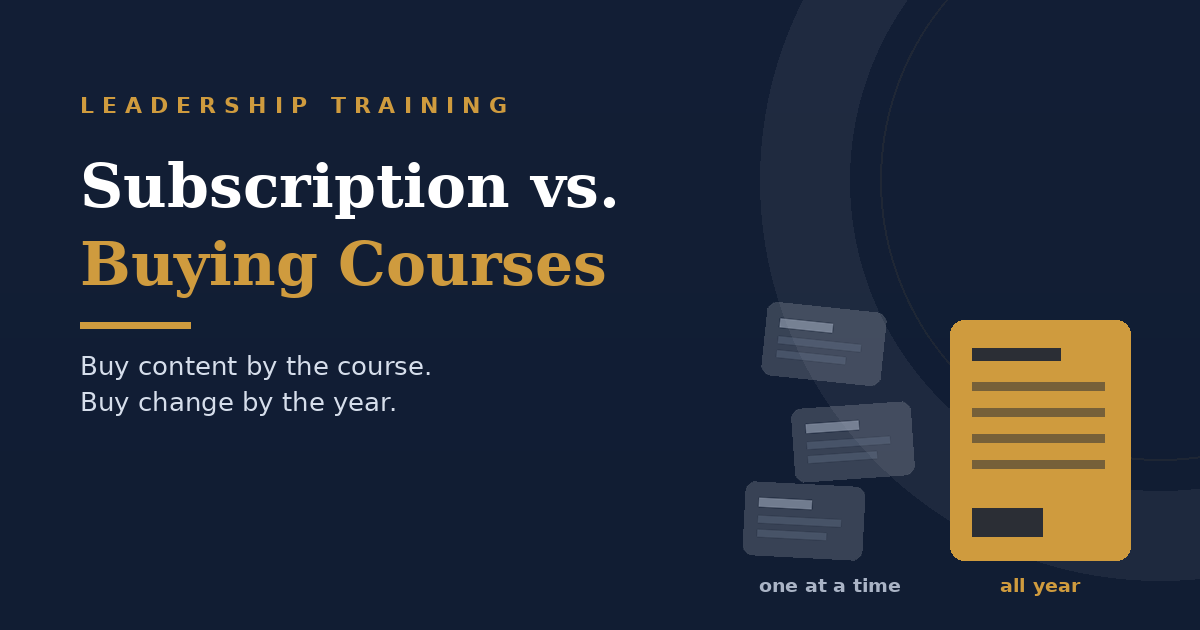

You can buy leadership training by the course or by the year.
Most people pick by sticker price. That’s the wrong variable.
The right variable is what you’re actually buying. A course is content. A year is a development plan. Those are different products that happen to live on the same shelf, and picking the wrong one is how smart people end up with certificates and unchanged Mondays.
Here’s the honest comparison, including the cases where buying a single course is still the right move.
The Two Models, Priced
Individual courses. Serious self-paced leadership courses run $200 to $500 apiece. University-branded single courses jump to $1,850 or more. You own what you bought, you finish it (or don’t), and coaching, if offered at all, is sold separately at a markup. We broke down the whole market in How Much Do Online Leadership Courses Cost?
Subscriptions. At the low end, content libraries: LinkedIn Learning at roughly $240 a year, Coursera Plus at $399. Thousands of courses, all-you-can-watch. At the higher end, development memberships: fewer courses, structured progression, coaching and tools included. Ours, Tandem Academy, is $1,000 a year for nine courses, an AI coach you can use weekly, and live small-group coaching with real coaches.
Same word, “subscription,” two different products. Which brings us to the real question.
What You’re Actually Buying
Buying a leadership course is like buying a book about swimming.
Useful. Necessary, even. But nobody learns to swim from the book, and nobody becomes a better leader from a weekend of video. The skill forms in the water: the delegation you actually hand off, the feedback you actually give, the meeting you actually run differently.
That’s not a motivational observation. It’s the core finding of decades of learning research: behavior changes through spacing, retrieval, feedback, and practice over time. Not through consumption.
Now look at the two models through that lens.
A single course is a sprint of consumption. Two weeks of watching, a certificate, and then nothing structured ever happens again. Whether you apply it depends entirely on your own discipline, which is exactly the thing nobody has in month three.
A year is the actual unit of leadership development. Twelve months is enough time to learn a framework, use it badly, get feedback, use it better, and have it become how you operate. The calendar isn’t a billing convenience. It’s the mechanism.
Where Cheap Subscriptions Fail Too
Before this sounds like a sales pitch for any subscription, the content libraries deserve their own warning.
A $240-a-year library with ten thousand courses has a Netflix problem: unlimited choice, zero structure, nothing at stake. You browse, you sample, you feel vaguely informed. Ask yourself the only question that matters: what do you do differently because of it?
Libraries are fine for exploring. As a development plan, all-you-can-watch is how nobody watches anything twice, and twice is where learning starts.
The failure of the cheap subscription isn’t the price. It’s that nothing in it asks anything of you.
The Checklist: What a Subscription Must Include to Beat Buying Courses
If you’re comparing any membership against à la carte buying, make it clear these five things are in the box.
Coaching, included, not upsold. The moment coaching becomes a separate line item, you’re back to buying courses with extra steps. In our Academy that’s two layers: an AI coach for short weekly working sessions on your real situations, and live group coaching with experienced coaches, capped at ten people, where you submit your challenge ahead of time. We’ve written about why training with coaching beats training alone, and the argument only gets stronger when the coaching is already paid for.
A structure, not a pile. A defined set of courses with an intended progression beats an infinite library. Nine courses you complete is worth more than nine thousand you scroll.
Tools you’ll reuse. Assessments, exercises, conversation guides. Things that leave the screen and enter your calendar.
New material on a schedule. A membership that never ships anything new is a course bundle with a renewal date. Quarterly is a reasonable bar.
A price on the page. If you have to talk to sales to learn the number, the number is not your friend.
What a Membership Year Actually Looks Like
The abstract argument is fine. Here’s the concrete version, using ours as the example.
Month one, you start a course matched to what’s actually in front of you. Say Leadership Essentials if you’re new to the role, or one of the change courses if a reorg is coming. You work through it in pieces, not a binge, because the point is what happens between sessions.
Every week, ten or fifteen minutes with the AI coach. Not a chatbot writing your emails. A structured working session: recall what you learned, debrief what you tried, commit to the next rep. It’s the “someone will ask” mechanism, available at whatever hour your week allows.
When something real and messy shows up, the peer who’s testing you, the change announcement that landed badly, you bring it to a live group session. You submit the challenge beforehand, a real coach works it with you, and you leave with a plan. The group is capped small, and the other managers’ situations turn out to be half your education.
Somewhere in the quarter, new material ships. You start the next course when you’ve actually applied the last one, not when the credit card allows.
By month twelve you haven’t consumed nine courses. You’ve run a year of deliberate practice with feedback, which is the thing a stack of individual course purchases was never going to become.
That’s what the $1,000 buys. Not access. Cadence.
The Math, Side by Side
Run a realistic year of development for one manager.
Buying individually: three serious courses at $250 to $400 each is $750 to $1,200, and that’s with no coaching. Add even four private sessions at typical market rates ($200 to $600 each) and you’re somewhere between $1,550 and $3,600.
One university certificate: $1,850 to $4,000. One course’s worth of content, cohort deadlines, no ongoing coaching.
Content library: $240 to $399. Cheapest by far, and worth exactly that if nothing changes on Monday.
Tandem Academy: $1,000. Nine courses, weekly AI coaching, live group sessions, tools, new releases through the year.
For context, enterprise leadership programs run $15,000 and up per person. That gap is the entire reason the membership model exists: the development structure big companies buy, at a price a manager at a 40-person company, or a manager paying for their own growth, can actually reach.
Quick test: whatever option you’re considering, divide the price by the number of behaviors you honestly expect to change. Cost per behavior is the only metric that survives contact with reality.
When Buying One Course Is Still Right
The honest section. Three cases where à la carte wins.
You have one specific, urgent gap. You’re leading a reorg announcement in three weeks and need change communication now. Buy the course that covers it. Precision beats structure when the clock is short.
Your employer will reimburse a course but not a subscription. Take the free money. A funded course beats an unfunded membership, and you can graduate to the membership later.
You’ve proven you self-apply. If you’re the rare person who finishes courses, builds practice plans, and recruits your own feedback, you’re the exception the à la carte model was priced for. Respect.
Everyone else, and that includes most of us, does better inside a structure that keeps asking.
One more honest note: if you genuinely only ever wanted one skill, one course is cheaper. The subscription bet is that leadership isn’t one skill, and every manager who’s had a difficult quarter knows how that bet settles.
When the Subscription Is the Obvious Call
You’re in or approaching a transition: new to leading former peers, first big team, first real change to lead. Transitions are twelve-month events. Buy the twelve-month tool.
You have no corporate program behind you. If your company is too small for $15K-per-head development, the membership is how you stop letting that set your ceiling.
You’re developing a small team, not just yourself. Two to five managers on the same material, coached in the same rhythm, start speaking the same language. That’s culture change at team scale, for less than one conference trip.
You’ve bought courses before and watched them evaporate. The problem was never you. It was the model: consumption without structure. Change the model, not your opinion of yourself.
Try Before You Commit
You don’t have to reason your way to a decision in the abstract.
Start with the free book at Tandem Academy. If you want proof instead of promises, book the 20-minute session and watch the coach work on your real situation before you spend a dollar. If it lands, membership is $1,000 a year, everything included.
Buy content by the course.
Buy change by the year.